Cleaner choices, backed by evidence. New issue of the newsletter every Thursday. Subscribe free

Tag: nutrition research

  • Seed Oils: What the Evidence Actually Says

    Seed Oils: What the Evidence Actually Says

    Evidence: Moderate

    Key takeaways

    • “Seed oils” like canola, soybean, corn and sunflower oil are high in an omega-6 fat called linoleic acid.
    • Major health organizations, including the American Heart Association, say there’s no evidence to avoid them, and replacing saturated fat with these oils is linked to better heart health.
    • The claim that seed oils cause inflammation hasn’t held up well in human studies.
    • The bigger issue is often the foods seed oils show up in: fried and ultra-processed foods.

    Seed oils have become one of the most argued-about topics in nutrition. Social media posts call them toxic and inflammatory; many nutrition scientists say they’re fine or even good for you. Since we’re all about cleaner choices backed by evidence, we looked at what the research actually says about whether seed oils are bad for you.

    What are seed oils?

    “Seed oils” usually refers to oils pressed or extracted from seeds, such as canola (rapeseed), soybean, corn, sunflower, safflower, cottonseed and grapeseed oil. They’re high in polyunsaturated fats, especially linoleic acid, an omega-6 fat. Linoleic acid is an essential fatty acid, meaning your body needs it from food.

    The case against seed oils

    Critics raise three main concerns:

    • Inflammation: linoleic acid can be converted into arachidonic acid, which is involved in inflammatory processes, so some argue more omega-6 means more inflammation.
    • Processing: many seed oils are refined with heat and chemical solvents.
    • Oxidation: polyunsaturated fats are less stable at high heat, especially when oil is reused for frying.

    What the evidence shows

    On heart health, the evidence leans clearly in favor of seed oils when they replace saturated fats like butter or lard. The American Heart Association says there’s no reason to avoid seed oils and plenty of reasons to eat them. A 2024 narrative review for health professionals concluded that epidemiological and clinical trial evidence indicates omega-6 fat intake is protective for the heart.

    On inflammation, the theory hasn’t held up well in people. Controlled trials in which adults ate more linoleic acid generally haven’t found increases in blood markers of inflammation. The Academy of Nutrition and Dietetics notes that only a small percentage of linoleic acid is converted to arachidonic acid, and that higher omega-6 intake is associated with better cardiovascular health.

    That said, not every question is closed. Some researchers still argue for more study of heavily processed and repeatedly heated oils, and much of the evidence comes from observational studies.

    Why we rated this “Moderate”: Major health organizations and many reviews support seed oils as a replacement for saturated fat, including evidence from clinical trials. We rate it Moderate rather than Strong because some debate continues about processing and high-heat use, and some of the newest reviews were funded by industry groups. How we rate evidence

    So why do seed oils have a bad reputation?

    Part of the answer is where people eat them. Seed oils are used heavily in fried foods, fast food and packaged snacks, which are linked to poor health for many reasons, including excess calories, refined carbohydrates and salt. Cutting back on those foods is a good idea. But the evidence points to the ultra-processed food as the problem more than the oil itself. Read what the biggest review found about ultra-processed foods.

    Practical takeaways

    • Don’t fear the bottle of canola oil. Using it instead of butter or lard is generally the heart-friendlier choice.
    • Rotate your oils. Extra virgin olive oil has strong evidence behind it and works for most home cooking.
    • Limit deep-fried and ultra-processed foods, which is where most people get the most seed oil.
    • Don’t reuse frying oil over and over, and store oils away from heat and light.

    Cleaner swaps to try

    We may earn a commission if you buy through links in our product picks. It never affects our ratings.

    • Everyday cooking: extra virgin olive oil
    • High-heat cooking: avocado oil or a refined high-oleic oil
    • Baking: canola oil, or olive oil in recipes where the flavor works

    The bottom line

    The evidence doesn’t support the idea that seed oils are toxic. Most major health organizations consider them a healthy replacement for saturated fat. The real win is cutting back on fried and ultra-processed foods, and cooking more at home with whichever oils you prefer. See easy ideas in 10 Pantry Swaps That Cut Ultra-Processed Foods.

    Want one evidence-checked story and three easy swaps every week? Subscribe to our free newsletter.

    Sources

    1. American Heart Association News. There’s no reason to avoid seed oils, and plenty of reasons to eat them. August 20, 2024.
    2. Academy of Nutrition and Dietetics. Nutrition Fact Check: Seed Oils.
    3. Narrative review of vegetable oils high in unsaturated fats and chronic disease risk. PubMed Central, 2024.
    4. AARP. Are Seed Oils Actually Bad for You?.
  • Ultra-Processed Foods: What the Biggest Review Yet Actually Found

    Ultra-Processed Foods: What the Biggest Review Yet Actually Found

    Evidence: Strong

    Key takeaways

    • A 2024 umbrella review in The BMJ pooled 45 analyses covering almost 10 million people.
    • Eating more ultra-processed foods was consistently linked to higher risk of heart-disease death, type 2 diabetes, anxiety, depression and early death.
    • These studies show strong associations, not absolute proof of cause, but a controlled trial also found ultra-processed diets lead people to eat more and gain weight.
    • You don’t need a perfect diet. Swapping the ultra-processed foods you eat most often is the most practical place to start.

    Ultra-processed foods make up a large share of what many Americans eat every day: packaged snacks, sugary cereals, soft drinks, frozen ready meals and fast food. For years researchers have suspected these foods are bad for health. In 2024, the largest review of the evidence so far put numbers on that suspicion, and the pattern was hard to ignore.

    Here’s what the researchers found, how strong the evidence really is, and what it means for your grocery cart.

    What are ultra-processed foods?

    Most food is processed in some way. Frozen vegetables, canned beans and plain yogurt are all processed, and that’s fine. Ultra-processed foods are different. Researchers commonly use a system called NOVA, which sorts foods into four groups by how much they’ve been industrially changed. Ultra-processed foods sit in the last group.

    They’re industrial formulations, typically made from extracted or modified ingredients like refined starches, sugars, oils and protein isolates, plus additives such as colors, emulsifiers, flavors and sweeteners. According to The BMJ, these products tend to be high in added sugar, fat and salt and low in vitamins and fiber.

    Common examples

    • Soft drinks and sweetened juice drinks
    • Packaged chips, cookies and snack cakes
    • Sugary breakfast cereals and cereal bars
    • Instant noodles and many frozen ready meals
    • Hot dogs, chicken nuggets and other reconstituted meats
    • Many flavored yogurts, packaged breads and pastries

    A quick rule of thumb: if the ingredient list includes things you wouldn’t find in a home kitchen, such as hydrogenated oils, maltodextrin, “natural flavors” or long chemical names, it’s probably ultra-processed. Our Ingredient Decoder breaks down what those names mean.

    What the biggest review found

    In February 2024, an international team published an umbrella review in The BMJ, one of the world’s leading medical journals. Instead of running one more study, they gathered 45 pooled analyses from 14 review articles, covering nearly 10 million participants, and graded how strong each link was.

    Higher intake of ultra-processed food was directly associated with 32 different health outcomes. The researchers rated the evidence as convincing for:

    • About a 50% higher risk of death from cardiovascular disease
    • A 48–53% higher risk of anxiety and common mental disorders
    • A 12% higher risk of type 2 diabetes

    They rated the evidence as highly suggestive for a 21% higher risk of death from any cause, a 40–66% higher risk of heart-disease-related death, obesity and sleep problems, and a 22% higher risk of depression.

    Notably, the review was not funded by companies involved in producing ultra-processed foods, according to the BMJ Group’s announcement.

    Why we rated this “Strong”: This is a large, peer-reviewed umbrella review in a top medical journal, with consistent results across many outcomes and millions of people, and a randomized trial (below) supports one likely mechanism. The limit: most of the underlying studies are observational, so they show associations rather than proof that ultra-processed food alone causes each outcome. How we rate evidence

    Does it prove ultra-processed foods cause harm?

    Not on its own, and the authors say so. Observational studies can’t rule out other factors. People who eat a lot of ultra-processed food may also sleep less, exercise less or have less access to fresh food. Some outside experts also noted that parts of the underlying research are weak.

    But there’s a reason researchers take the link seriously. In a tightly controlled 2019 trial at the U.S. National Institutes of Health, adults lived in a research clinic and ate either an ultra-processed diet or a minimally processed diet for two weeks each, eating as much as they wanted. On the ultra-processed diet, people ate roughly 500 more calories a day and gained weight. On the minimally processed diet, they lost weight. The meals offered were matched for calories, sugar, fat, fiber and salt.

    That doesn’t answer every question, but it shows one clear way these foods may affect health: they’re easy to overeat.

    What this means for your cart

    The goal isn’t zero. Ultra-processed foods are convenient and sometimes the only realistic option. The research points toward shifting the balance, especially for the foods you eat most often. Here’s a practical approach:

    1. Start with drinks. Swapping soda or sweetened drinks for water, sparkling water or unsweetened tea is one of the simplest, highest-impact changes.
    2. Fix your most frequent snack. Trade one daily packaged snack for fruit, nuts, plain yogurt or popcorn you make yourself.
    3. Read the ingredient list, not just the front of the box. Short lists with recognizable ingredients are a good sign. Our guide to decoding labels can help.
    4. Cook a few more meals from scratch. Even simple meals like eggs, rice and beans or a sheet-pan dinner are minimally processed.
    5. Keep easy staples on hand. Frozen vegetables, canned beans, oats and plain frozen fruit are processed, but not ultra-processed, and they make quick meals easier.
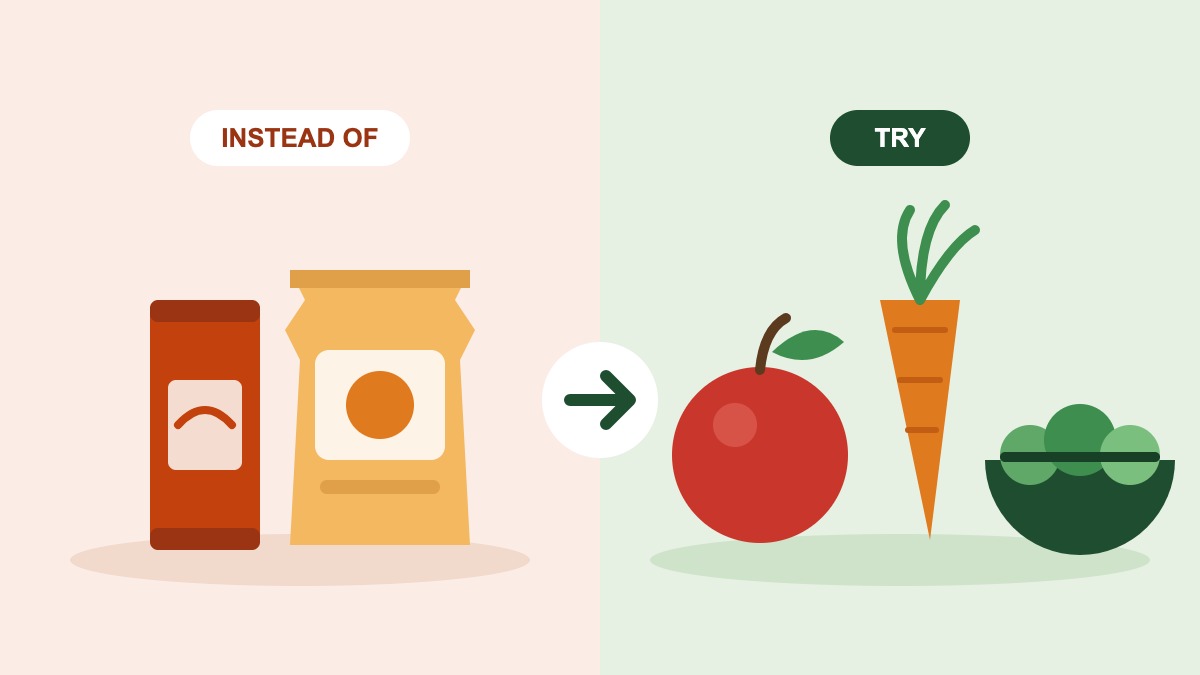
    Illustration: swap soda and chips for an apple, carrots and greens

    Cleaner swaps to try

    We may earn a commission if you buy through links in our product picks. It never affects our ratings.

    • Instead of flavored chips: air-popped popcorn with a little olive oil and salt
    • Instead of sweetened yogurt cups: plain yogurt with fresh or frozen fruit
    • Instead of sugary cereal: plain oats with cinnamon and fruit
    • Instead of soda: sparkling water with a squeeze of citrus

    More ideas in our Swaps section.

    The bottom line

    The largest review to date found consistent links between ultra-processed foods and dozens of health problems, from heart disease to anxiety, and a controlled trial suggests these foods make it easy to eat more than we need. You don’t need to be perfect. Focus on the ultra-processed foods you eat most often, swap a few for whole or minimally processed options, and build from there.

    Want one evidence-checked story and three easy swaps every week? Subscribe to our free newsletter.

    Sources

    1. Lane MM, Gamage E, Du S, et al. Ultra-processed food exposure and adverse health outcomes: umbrella review of epidemiological meta-analyses. BMJ. 2024;384:e077310.
    2. BMJ Group. Consistent evidence links ultra-processed food to over 30 damaging health outcomes. February 2024.
    3. Hall KD, Ayuketah A, Brychta R, et al. Ultra-processed diets cause excess calorie intake and weight gain: an inpatient randomized controlled trial of ad libitum food intake. Cell Metabolism. 2019;30(1):67–77.